🍎 A Sydney Specialist’s Guide to Smart Waste Food Disposal
“Waste Food Disposal in Sydney: Your Essential Guide for Homes & Businesses”
Sydney Food Waste Disposal: Home & Business Guide
1. Introduction: The Urgency of Smart Waste Food Disposal in Sydney
As a leading waste management specialist in Sydney, We see the challenge and the opportunity in every bin. Waste food disposal is more than just throwing away scraps; it's a critical environmental and economic issue for our city. Landfill space is finite, and decaying food generates harmful greenhouse gases.1
Get a quick quote
Under no obligation
This comprehensive guide will arm Sydney homeowners, restaurants, cafes, and food businesses with the knowledge to manage food waste efficiently, comply with local council and NSW EPA mandates, and contribute to a sustainable Sydney.
2. What Is Food Waste and Why It Matters
Food waste includes any food—edible or inedible—that is discarded, lost, or uneaten. It’s a massive drain on resources, including water, land, energy, and labour used in its production.2
When food is wasted, it contributes to global warming.3 In landfill, it decomposes to produce methane, a potent greenhouse gas much stronger than carbon dioxide.
The economic cost to the Australian economy is currently estimated at around $36.6 billion each year.4 For an average NSW household, this means throwing away approximately $1,036 worth of food annually.5
3. Overview of Food Waste in Sydney: Statistics & Trends
Sydney's efforts to curb waste are essential, with households and businesses being the largest contributors.
In NSW, more than a third of the waste generated by households and sent to landfill is food.6
Approximately a quarter of all NSW business waste going to landfill is food.7
The good news is that the NSW Government's Love Food Hate Waste program is supported by data showing simple changes can reduce household food waste by up to 40%.8
4. Types of Food Waste: Household, Commercial, and Industrial
Understanding the source helps target the solution.
| Type of Waste | Primary Sources | Key Waste Components |
| Household | Homes, apartments | Plate scrapings, spoiled food, fruit/veg peelings, bones, coffee grounds, tea bags. |
| Commercial | Restaurants, cafes, retail, institutions | Preparation scraps, expired stock, bulk spoilage, customer plate waste, processing by-products. |
| Industrial | Food manufacturers, large processors | Production line discards, rejected batches, processing residues. |
5. Sydney City Council’s Food Waste Disposal Guidelines
The City of Sydney and surrounding councils are progressively rolling out dedicated services to manage food waste separately from general garbage.9
FOGO (Food Organics and Garden Organics): This is the key residential strategy, allowing food scraps to be placed in the green-lid garden organics bin.10
The City of Sydney Council has an active food scraps recycling service for over 22,000 households and is planning a full roll-out to all residents by 2030.11
Check your local council’s website (e.g., City of Sydney, Inner West, Randwick) as acceptance criteria and collection days can vary.
6. Waste Food Collection Services in Sydney
There are generally two collection streams for food waste in Sydney:
Council Kerbside (Residential FOGO): For participating areas, this typically involves a small kitchen caddy and biodegradable liners to collect all food scraps (including meat, dairy, and bones), which are then transferred to the larger green-lid bin.12
Commercial Waste Providers: Businesses must engage private waste contractors to manage food waste. Dedicated "Food Organics" bins are available, which are collected and sent to commercial processing facilities for composting or anaerobic digestion.13
7. How Food Waste Is Processed and Managed Locally
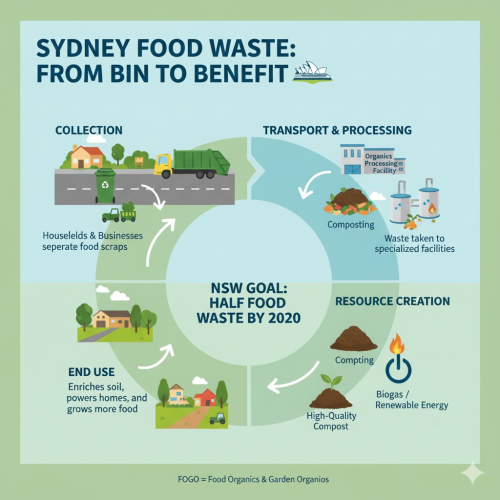
Sydney's recycled food scraps are not simply buried; they are transformed into valuable resources.14
Composting: Food scraps are mixed with garden waste and processed into nutrient-rich compost, which is used in farming and landscaping to improve soil health.15
Anaerobic Digestion (AD): This innovative technology breaks down food scraps in an oxygen-free environment to produce biogas (renewable energy) and a nutrient-rich digestate (fertiliser).16 AD facilities are key to managing large commercial volumes.
8. Composting at Home: Step-by-Step Guide
For Sydney residents whose council has not yet implemented FOGO, or those who prefer an alternative, at-home composting is a fantastic option.
Choose your method: A simple compost bin for backyards, a worm farm (great for balconies), or a Bokashi bin (ideal for apartments, accepts all food types).17
Collect Scraps: Use a small kitchen caddy with a lid for easy collection.18
Balance Ingredients: Aim for a good mix of 'greens' (nitrogen-rich, like food scraps) and 'browns' (carbon-rich, like dry leaves, shredded paper, or wood shavings).
Maintain: Keep the pile moist (like a damp sponge) and turn it regularly to aerate it and speed up decomposition.19
9. Commercial Food Waste Disposal Solutions
Sydney's cafes, restaurants, and food retailers are facing increasing pressure and new mandates to separate food waste.20
Dedicated Organics Bins: Partner with a specialist waste provider for clearly labelled, regular collection of food waste for processing.
Onsite Processing: Some larger businesses utilise equipment like food dehydrators or macerators to reduce the volume of food waste before collection, cutting down on disposal costs.21
10. Innovative Recycling and Anaerobic Digestion Programs
NSW is investing heavily in infrastructure to support the circular economy.
Regional Processing: Many FOGO and commercial food waste streams are transported to large, advanced Organics Processing Facilities (AOFs) located outside of Sydney.
Biogas Production: Facilities employing Anaerobic Digestion are turning Sydney's scraps into renewable energy that can power homes and businesses.22
11. Impact of Food Waste on the Environment and Landfills
The environmental consequences of poor food waste disposal are severe.23
Greenhouse Gas Emissions: Methane from decomposing food in landfill is a major contributor to climate change.
Leachate Pollution: Liquid runoff (leachate) from landfills can contaminate groundwater and local waterways if not properly managed.
Landfill Overload: Sydney's available landfill space is rapidly depleting; effective FOGO recycling is essential to avert a looming waste crisis by 2030.24
12. Government Regulations and Sustainability Goals (EPA NSW)
The NSW Environment Protection Authority (EPA) is driving significant changes with clear mandates.25
NSW FOGO Mandate: Legislation requires all NSW households to have a FOGO collection service by July 2030.26
Business FOGO Mandates: Businesses will be required to separate food waste in stages, starting from July 1, 2026, for large-volume generators (e.g., supermarkets, hospitals, large hospitality venues).27
Resource Recovery: These regulations support the national goal to halve Australia’s food waste by 2030.
13. Benefits of Proper Waste Food Disposal
The shift to better food waste management offers substantial benefits for all Sydneysiders.
Environmental: Reduced greenhouse gas emissions and lower reliance on finite landfill space.28
Economic (Businesses): Lower general waste disposal costs (as food waste is often cheaper to process than landfill waste) and potential savings from better stock management.29
Community: The creation of valuable, nutrient-rich compost for local parks, farms, and gardens.30
14. How to Reduce Food Waste in Households
The best disposal is avoidance. The Love Food Hate Waste program offers simple yet effective tips:
Plan and Shop Smart: Use a meal plan and shopping list to avoid overbuying.
Store Correctly: Understand best-before and use-by dates, and store food in the correct conditions (e.g., keeping potatoes separate from onions).
Love Your Leftovers: Turn scraps into new meals (e.g., vegetable peels into stock, stale bread into croutons).31
Know Your Dates: Freeze items like bread, milk, and meat nearing their use-by date.
15. Waste Disposal Tips for Restaurants and Cafes
The hospitality sector can make the biggest immediate impact by implementing these best practices:
Waste Audit: Measure and track where your food waste is coming from (preparation, spoilage, or plate waste) to identify hot spots.32
"First In, First Out" (FIFO): Ensure older stock is used before new stock.
Menu Engineering: Design menus that utilise overlapping ingredients to minimise trim waste.
Food Rescue: Partner with food rescue charities like OzHarvest to donate quality, surplus food instead of discarding it.33
Dedicated Organics: Separate all unavoidable food scraps into a designated organics bin for commercial collection.34
16. Sydney Suburbs Leading in Food Waste Recycling
Many Sydney councils are already successfully implementing FOGO services, showcasing regional leadership.
Suburbs under councils like the City of Sydney (in participating areas), Inner West, and others are actively transitioning to food organics collection.
These areas provide excellent case studies on how FOGO can successfully integrate into dense urban living, including apartment blocks.
17. Common Mistakes to Avoid in Waste Food Disposal
Ensure your efforts are effective by avoiding these common pitfalls:
Contamination (FOGO): Placing non-compostable items (like plastic bags, plastic packaging, or disposable coffee cups) in the food scrap bin.
Improper Storage: Allowing food waste to smell or attract pests by not using a sturdy caddy with a sealed lid, or failing to use the provided biodegradable liners.
Not Donating: Throwing away good-quality, surplus food that could have been donated to feed people in need.
Mixing Commercial Waste: Businesses putting food scraps in the general red bin, which will soon be non-compliant with EPA mandates.
18. Frequently Asked Questions (FAQs)
Q: What food scraps can I put in my FOGO (green lid) bin in Sydney?
A: In most Sydney FOGO services, you can include all food scraps, including meat, small bones, dairy, seafood, fruit, vegetables, bread, and coffee grounds.35 Always check your specific council's guidelines.
Q: Are compostable packaging items allowed in the FOGO bin?
A: No. Only food scraps and garden waste are accepted. Even compostable packaging must typically go into the general waste bin unless otherwise advised by your council, as commercial composting facilities can't always process them.
Q: How can a small cafe manage the new EPA business mandates?
A: Start by measuring your current food waste. Even small generators must plan for the future 2030 mandate. Begin by sourcing a small organics bin, training staff on separation, and actively reducing waste through smart inventory management.
Q: How do I stop my kitchen caddy from smelling?
A: Use the provided ventilated caddy with compostable liners, place it away from direct sunlight, and empty it into your main FOGO or organics bin every 2–3 days. Layering with newspaper or paper towels can also absorb moisture and odour.
Q: Is it safe to donate prepared food?
A: Yes, reputable food rescue organisations like OzHarvest accept prepared and surplus food, provided it meets strict food safety and handling standards.36 This is a regulated and protected process.
19. Success Stories and Local Case Studies
The Apartment Composting Challenge: Several City of Sydney apartment blocks have successfully introduced shared food scrap drop-off points or Bokashi systems, proving that space-saving solutions work in high-density living.
Local Cafe Waste Reduction: Cafes participating in the EPA's Bin Trim program have achieved measurable reductions in general waste disposal costs by redirecting food scraps and improving stock rotation, often saving thousands of dollars annually.
20. Actionable Tips for Sustainable Waste Practices
To be a true Sydney 'waste food fighter,' adopt these practical steps:
Homeowners: Start using a kitchen caddy today, even if it's only for a home compost or worm farm. Focus on meal planning to reduce edible waste.37
Restaurants & Cafes: Conduct a staff workshop on the new EPA mandates and the importance of FIFO (First In, First Out) in your cool room. Contact a food rescue charity to start a donation partnership.
All Sydneysiders: Choose a day to be 'Leftover Day' and commit to using up all uneaten food before cooking a new meal.
Conclusion & Key Takeaways: Sydney’s Zero-Waste Future
The future of waste food disposal in Sydney is clear: moving from a linear 'take-make-dispose' model to a circular economy.38 The new FOGO mandates and commercial regulations are not obstacles but catalysts for positive change. By embracing composting, utilising council services, and prioritising waste reduction, Sydney can not only save money but also significantly reduce its environmental footprint.
Take the next step today!
For Homeowners: Find out if your council offers FOGO and request a kitchen caddy if you don't have one.
For Businesses: Don't wait for the mandate—contact a commercial waste expert to set up a dedicated organics bin and start your food waste audit immediately.
Everyone: Commit to the "Love Food Hate Waste" challenge and cut your edible food waste in half this month!
Would you like me to find the specific current FOGO collection guidelines for a particular Sydney council area?
Here is a summary of the latest, state-wide best practice guidelines that all Sydney councils are aligning with:
🟢 What is Always Accepted in FOGO Bins
🛑 What is NEVER Accepted in FOGO Bins (Contaminants)
The State-Wide Mandate
The Protection of the Environment Legislation Amendment (FOGO Recycling) Bill mandates that by July 1, 2030:
All NSW councils must provide a FOGO collection service to every household that currently receives a red bin service.
Food organics must be collected weekly to minimise odour issues.
This move ensures consistency and is expected to divert nearly one million tonnes of FOGO waste from landfill each year.
The link below provides more detail about the NSW Government's plan for FOGO collection across the state. FOGO mandates and rollout | EPA - NSW Environment Protection Authority